
With great data comes great responsibility
Our response to Nigel Farage's use of our data
Max Deeley, Communications Director, Nuke From Orbit
Date: 31st July 2025
Getting your research data quoted by one of the UK’s most prominent politicians is both a blessing and a curse.
On the one hand, it’s exposure for your brand. And as the saying goes, there’s no such thing as bad news. On the other hand, there’s a chance that it misrepresents the point you were trying to make. Maybe, that’s on us. Maybe, our messaging hasn’t been clear enough.
Motive matters
First, a bit of context. Why did we conduct the research that has caused such a furore? We’ve run it twice now, and the first time we did it wasn’t to back up our claim, but to validate a theory. Our first research project was conducted to ensure that we’re actually solving a serious problem and that our solution aligns with the needs of society. Because if it didn’t, there wasn’t a business there worth pursuing. It was one of the first things we did as a company and set the tone for what was to follow.
With that out the way, let’s get into the issue of the day.
What did Farage say?

At a Reform press conference last week, Nigel Farage said, “One in three people, at some point, have been subject to phone theft. It’s almost unbelievable.” Fact-checking his claims for The Guardian, Eleni Courea said, “This appears to have come from a survey of 1,000 people by a UK fintech startup called Nuke From Orbit, rather than the police-reported figures that Farage said he preferred. According to the Metropolitan police, 80,000 phones were reported stolen in London in 2024, which suggests the crime affected far fewer than one in three people.”
Can two things be simultaneously true and untrue at the same time? Let’s find out.
What did our research say?
Our research revealed that 29% of consumers have experienced phone theft, up from 17% the previous year. In our press release, we stated that this represented nearly a third. But upon reflection, we believe that may have been an unnecessary exaggeration on our part. 29% is as close to a quarter as it is to a third, and in our efforts to be heard, we went with the fraction that shouted the loudest. That’s not to say that media outlets that reported on the research at the time didn’t have a duty to fact-check us, but we understand what a busy bullpen is like.
But numerical semantics aside, this rather misses the point. Firstly, Farage has not misquoted the stat we put out there. He specifically states that this figure applies to the entire lifetime of an individual. That said, he’s tied it to London, when this was the figure from across the UK. However, we’re not entirely sure why it is appropriate to compare that to an official crime statistic that only relates to phone thefts in a single calendar year. If you wanted to make that comparison to our data, then you’d need to dig a little deeper.
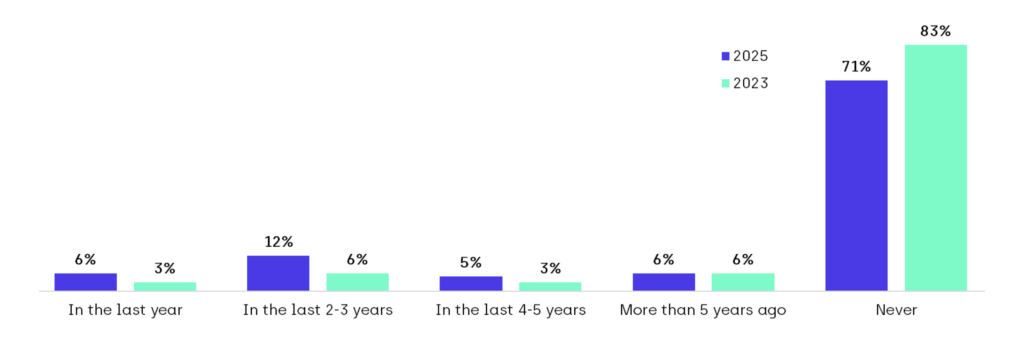
Over the last year (April 2024-April 2025), if you drill into our data properly, Smartphone theft is actually only at 6%. London’s population is around 8.9 million. Is 80,000 (the number from the official crime stats) 6% of the population of London? No, it’s not. However, if you take the crime statistics at face value, they assume that every phone theft gets reported.
Therefore, we need to delve deeper into the data to determine if it reveals any insights into why there might be a discrepancy between our data and the official crime statistics.
Who fact-checks the fact-checkers?
One of the most eye-opening insights from our research report was the immediate actions taken by those who’ve had their phone stolen. We then compared those responses to what people who hadn’t had their phone stolen would hypothetically do. And when it comes to reporting a theft to the police, when the rubber hits the road, it’s a long way down the priority list.
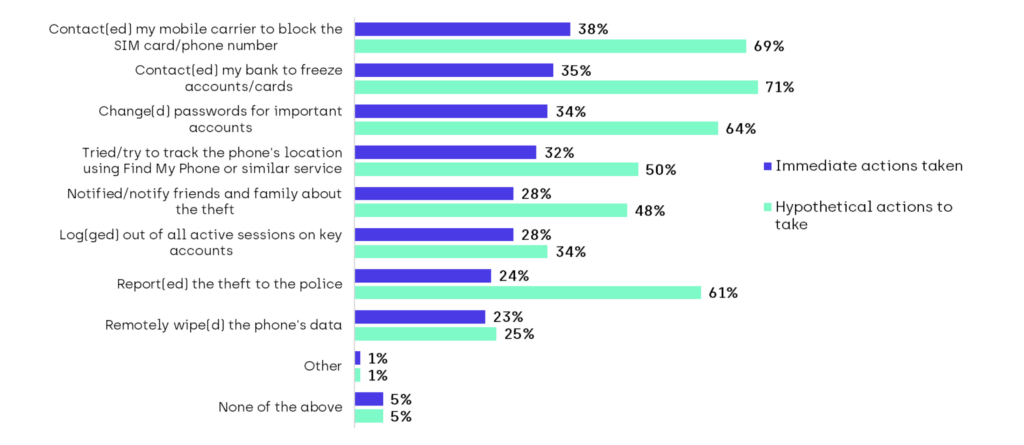
So that 80,000 official crime stat? If our data is even in the right ballpark (it has a statistical reliability of ±3% with 90% confidence), you can probably quadruple it and weight it slightly more in urban areas like London. The complete data set, which breaks down the findings by geographical categorisation, is available upon request. Ultimately, we can’t find any issue with Farage presenting our data in the way he did (except saying it related to London only, not the whole of the UK). Even if it was as hyperbolic as we ourselves are probably guilty of making it.
Our data isn’t political
As much as we love being in the news, we want to emphasise that our research was never intended to be political. We don’t much care who the government is. We’re not interested in apportioning blame, scapegoating police, migrants, or whoever society’s boogyman is today. We’re interested in finding a solution to the problem. We’ll work with any and all stakeholders who are serious about protecting consumers.
No single individual is responsible for tackling this problem. Don’t hyper-fixate on the individual; start looking at the entire ecosystem. That’s what we’re doing, and we welcome anyone who wants to join us on that journey.